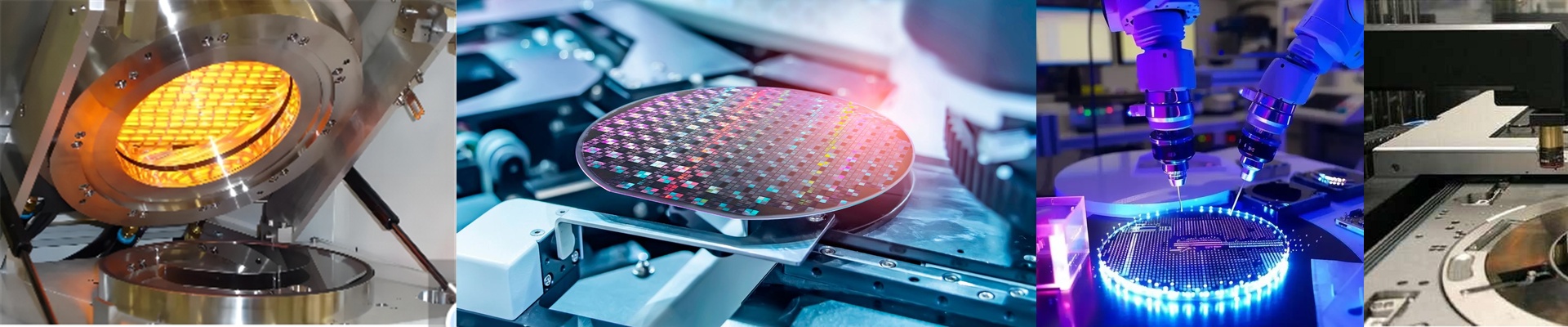
On the packaging line, the clock starts the second the chip lands. You align, dispense, cure. The lamp fires up. If the thermal profile drifts even a degree, you’re gambling with bondline voids, flux that doesn’t fully activate, or epoxy that cures unevenly across the array. In Mini LED, those defects don’t just kill one unit—they tank yield across thousands of micro-emitters and widen the binning spread so your luminance uniformity targets slip away. We built the Mini LED chip packaging lamp for that reality: a halogen-based, ultra-stable thermal source designed to run with wafer-level discipline—tight uniformity, tight repeatability, and zero tolerance for particle contamination.
What matters, technically
Mini LED chip packaging isn’t general illumination. It’s a thermal process executed under microscope-scale tolerances. The lamp has to deliver repeatable heat to a defined area, fast, without adding variability that propagates into yield loss. We spec a halogen lamp with controlled spectral output, tuned for rapid thermal response and stable filament behavior across repeated on/off cycles. The core performance is temperature control, not brightness.
- Temperature uniformity:±0.1°C across the target zone. In practice, that means the center of the bond site and the edge of the array see the same thermal condition, so you stop chasing hot spots and cold margins.
- **Photoresist bake compatibility:**The lamp supports both soft bake and hard bake behaviors needed in packaging-adjacent steps—removing solvent cleanly, setting the polymer, and avoiding overshoot that can blow out critical moisture control.
- **Cleanroom compatibility:**Built for Class 1–100 environments. Materials and finishes are chosen to minimize outgassing and stand up to standard cleaning agents. The point is simple: keep particle counts where your process keeps them.
- **Zero particle generation (by design):**The optical path and lamp enclosure are sealed and managed to prevent dusting from filament debris or airborne particulate. Cleanliness isn’t an afterthought here—it’s a spec.
- **24/7 reliability with zero unplanned downtime:**This isn’t marketing. It’s a design requirement. The lamp is engineered for continuous operation, with thermal mass and driver control that prevent filament shock and keep output stable over long runs.
- **Process repeatability:**Every bake, every cure, every time. The system records and repeats the same thermal curve, so qualification doesn’t get re-done every shift. The supporting hardware matters, too. We provide standardized interfaces and mounting that match common packaging equipment footprints, so integration doesn’t turn into a custom project. Power delivery is matched to the lamp and thermal controller to avoid line noise and voltage sag that can introduce jitter during sensitive cure steps.
Why it works in this environment
Mini LED packaging is a string of small, precise thermal events. You need heat exactly where you want it, exactly when you need it—and you need it repeatable across millions of cycles. In this setting, the lamp isn’t just a light source. It’s part of the process recipe. When the lamp holds ±0.1°C uniformity, the difference shows up on the floor. Bondline consistency improves. Rework drops. Binning tightens because the array-level thermal history is consistent across the panel. You stop compensating for thermal gradients with process margin. Cleanroom compatibility matters because packaging lines don’t forgive much. Particle generation from a lamp can contaminate flux, create micro-shorts, or cause cosmetic defects that fail inspection. A lamp built for semiconductor discipline keeps the environment stable, not just the device under test. Reliability translates straight into uptime. Unplanned lamp failures force line stoppages, requalification, and scrap. Our lamp is built to run through night shifts and weekend changeovers, with thermal cycling behavior that doesn’t degrade output or introduce drift. Energy use isn’t a vanity metric. The halogen system is efficient in the way manufacturing cares about: it hits setpoint fast, holds it steady, and avoids wasted heat outside the target zone. That reduces energy draw without compromising thermal control. The result isn’t flashy. It’s operational.
- Fewer thermal excursions.
- Fewer re-bakes.
- Fewer rejects tied to cure profile.
- A packaging line that behaves like a process, not a variable.
What you need to know up front
No industrial lamp is plug-and-play on a high-precision line without planning. The lamp needs proper thermal integration. Mount it to a stable fixture with defined airflow and clearance, so the thermal controller can maintain uniformity without fighting ambient drafts or equipment heat loads. Poor mounting tolerances can introduce tilt, misalignment, and uneven heating—even if the lamp itself is stable. Compatibility is also process-specific. If your line runs aggressive solvents or high-humidity cures, confirm the seals and materials against your chemical list. We provide material compatibility guidance to match your cleaning and flux profiles. And the lamp performs best when paired with the right thermal sensing strategy. For the tightest repeatability, use a calibrated sensor at the work plane, not at the lamp body. Temperature at the emitter isn’t the same as temperature at the bond site. Mini LED chip packaging doesn’t tolerate guesswork. It runs on specs, discipline, and equipment that behaves the same way tomorrow as it did today. If your line needs thermal precision that meets wafer-level expectations, this lamp is engineered to deliver it—consistently, cleanly, and without interruption.